Showing posts with label permaculture. Show all posts

11 June 2010

Our container house


For a few years now, Sunshine and I have been researching shipping container houses as an alternative means to affordable housing. The key to a container based house is the portability. Our 60m2 free standing design retains that portability, with all external elements such as roofing, doors and walls, fitting inside a container ready for transport, quick setup and quick break down.

The reason we want a portable house is so we can move it temporarily onto rented land, save up for our own land, and relocate it to settle and extend. Our plan is a two stage approach to home and land ownership, attempting to keep our weekly payments as low as possible while we go.

If you have a small section of land you could rent us, we can offer you between $50-100 rent per week. We'd then secure a loan of $40 000 for the prefabrication, additions and delivery of our container house. The weekly repayments on such a loan would be $250 over 5 years. The land rent and house repayments together would total $350 per week. We think we could save between $100-200 per week, or $5-10,000 per year, $15-30,000 over 3. That's a deposit for our own land, and once we had our own land, we'd move off yours, leaving behind a little fruit orchard, a herb garden, and a small rammed earth pad, where we once stayed.


Costing breakdown - new, recycled and 2nd hand materials:
  1. 2 modified 20foot high cube containers delivered: $10000
  2. Roof and trusses: $7000
  3. Insulation and linings: $3000
  4. 4x (1.2x3m) sliding, timber framed, double glase walls: $5000
  5. 1x (4.8x3m) back wall with window and door: $3000
  6. 6x5m rammed earth floor: $3000
  7. Kitchen: $2000
  8. Waterless toilet: $2000
  9. Shower: $1000
  10. Plumbing, storage, pump, outlets: $3000
  11. Power generator, storage, cable, points, lights: $5000
  12. Rocket fire, thermal mass heater: $500
  13. 2x doors: $1200
________
$45900 for stage one


If you think you can offer us a small section of land, let's talk.

06 June 2010

The local paper heats my water

The Canberra Times ran a story on our compost hot water system today, after a local radio station rang up for a quick live interview a few days ago.


Patrick Blampied is doing a great job with the media and PR for the Permaculture Research Institute of Australia, and sent out a press release about me after we met through Youtube. I'm more than happy to help build their profile in Canberra, although between the journalist, Pat's press release, and me seeing the story in print, some minor corrections and clarifications are needed:

  • I don't start each day with a warm feeling about environmental sustainability. I get that feeling working towards conviviality.
  • The correct order for being inspired to try this started with a Youtube video by Permascience, leading to information about Jean Pain, eventually seeing a video by Patrick that the Permaculture Research Institute of Australia were using the method too.
  • My pile (version 3 that is) is made of horse manure, straw and woodchip, not paper. Paper is a good suggestion - but slightly harder to come by around here.
  • I don't think or imply this system is for everyone, and I don't think it would reasonably replace existing systems.. not before a bit more research and development was done. I have concerns about the HDPE pipe possibly putting a chemical into the water for a start, and I think the biomass needs to be semi sealed to keep flies away. Patrick and I reckon something like a wheelie bin would probably be good, hooked up to a storage tank, with a replacement bin at the ready each week or so. Either that, or use the V3 system for room heating instead of shower water.
Apart from those minor points, it was great to get some interest from the local paper, and I hope it helps lead me to good local connections for progressing this and other projects. Thanks Patrick.

22 May 2010

Starting a rocket stove thermal mass heater

Its getting cold in Canberra. The fire place in our house is smokey and cold. The gas heating is too easy and expensive. Its time we learned how to build a rocket fire!

I discovered rocket fires last year when Permaculture Keith blogged about them. That lead to a couple of Youtube videos, which lead to meeting Erica and Ernie in Portland Oregon to see one in action.

Since that visit, Sunshine and I have been busy selling our house in NZ, moving to Australia, and having a baby. Now in a rental, its difficult to commit to a full build, but I've found a bit of time to study the method.

Basically, a rocket stove thermal mass heater is a super efficient wood fuel heater that can be built by just about anyone, using waste and/or easily collectible materials. To give you an idea, in Dunedin we used an efficient and certified wood burner that used about 4-6 cubic metres of wood per year. Erica and Ernie told us they use about 1-2 cubic metres in their rocket heater, and their house was less insulated than ours!

If you want to get a sense of what a full rocket stove thermal mass heater is, this is a great introductory video:


Here's the book that the video refers to.

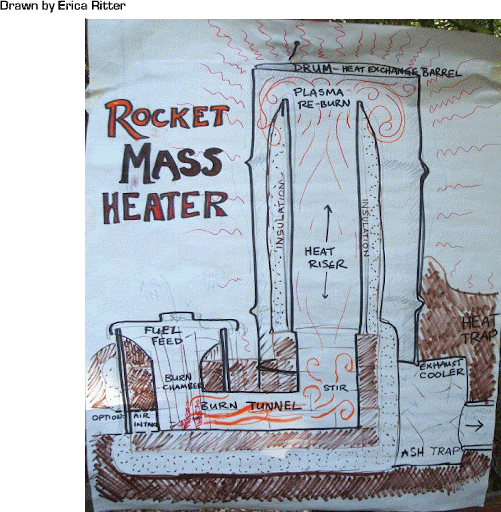
And here's a really good illustration by Erica, of the critical design of the rocket stove. At that link are a series of photos documenting a full build, including the thermal mass heater.

Here's another photo documented installation with some adaptations to the standard design, by Michael Blaha.

And I started the Wikipedia article to see where it might go.

My attempts so far
So begins my attempts to study and learn this technique for heating. After the usual terrible time trying to source materials in Canberra, here's a series of videos of my first mock up.


Canberra is an incredibly difficult find out about anything online. The websites are crappy and the search results are worse. As a result, sourcing materials is frustrating. All we needed was some short lengths of steal pipe at varying diameters, a few steal drums of varying sizes, about 10 fire bricks, and 10 normal bricks. So I baled the family into the care and drove around looking for word of mouth. The main waste recycle facility was useless. We found private waste recycle yards that looked promising, but were all locked up with no one around. Everyone we spoke to directed us out to Fyshwick, the industrial hub of Canberra. There we found some materials, but all set at exorbitant prices :( It seems what useful materials is recycled, is pretty well stitched up by business. But we did manage to scrape together a few bricks and some guttering just to get this first mock up made.

The hunt for better materials continues...

10 September 2009

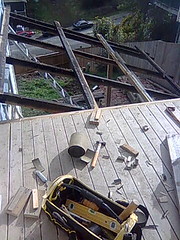
Side awnings finished

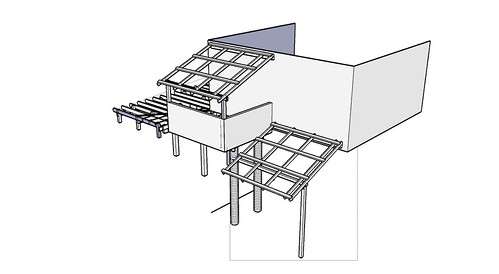
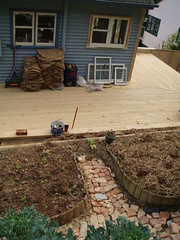
Before we went to the US for a month, Sunshine and I finished one of the side awnings. After we got back, we finished the other. Now we have great outdoor space on the deck to use when its raining - like drying cloths, or potting plants, or some minor building work. The awning down below offers us huge storage for building materials, or a green house in the future.

We used new H5 treated 100x100 posts, with recycled H3 and 4 100x50s. We saved a tonne of money with the recycled wood and they were nice and straight and very dry. We used the top of the line polycarbonate sheeting that comes with a 15year guarantee and cuts out UV rays. The guttering dilivers the water away from all footings. Will dig a gravel trench for over flow and put a small tank for garden watering.

Already we can feel a difference in warmth. Our original plan was to close them in with second hand windows. We still could, but have been surprised by the warmth offered as they are now! It would be amazing if the awning was continued around the front of the house, offering extended indoor/outdoor space below, and helping to heat up downstairs. Going this large (over 15m2) however would require a permit. Perhaps 2 separate awnings would get around that.

More photos

09 April 2009

Rhubarb


Stuart and Gabrielle give a good tip for growing rhubarb and making cocktails from a rhubarb cordial!

Rocket stove mass heaters!


Another very inspiring idea I knew nothing about, until Keith blogged it that is! Rocket stoves with mass heating.

I'm seriously considering building one of these downstairs. We have a log burner upstairs, and we need to install some thermal mass around it to make it more efficient, but downstairs has no heating! On the one hand we could extend the log burner downstairs, but I think I'd rather build the rocket down there for my learning's benefit, try and make it so it effectively heats down and upstairs, then consider uninstalling the log burner and selling it to recover costs... permits will be an issue :(

Here's a great video Keith found:

Here's the book that the video refers to, but I'm gutted to find my local library doesn't have a copy :(

And here's a really good illustration of the functional design from Erica, along with many other photos she took during a build in the US. Thanks Erica!

Here's another photo documented installation with some adaptations by Michael Blaha.

Update:
I started a Wikipedia article to see where it might take me information wise. Also, an Appropedia page to document our progress and hopefully meet experienced people.

25 January 2009

New door and a gate

Put a gate in the fence between the neighbour's and us. We visit each other often, trade food, and generally help each other out and a gate has been talked about for a long time. We plan to combine energy and produce a lot of food this year I think.

I also put a new door in the back of the house. We picked it up for $40 from Hall Bros (really cheap!). It has a big reinforced window in it so the entry hall gets light now. Even at night, the outside light gives good light through the window.

Lighting is an interesting design challenge in the house. Obviously we have replaced all globes with pearl energy savers at the lowest wattage we could get (11 Watts, still looking for less), and now its a matter of positioning the lights so that they give the maximum amount of useful light. Right now for example, we have 1 light on. It lights the lounge room and the kitchen slightly, as well as our bedroom through the glass doors. I've already mentioned that the outside light lights the hall, and the kitchen light lights the deck through the windows. I don't think there is ever a time we have more than 3 lights on. Thats 33W per hour as apposed to 180W per hour if we had normal light bulbs, or 360W or more if we used twice as many lights. This, combined with fire heating (and cooking), gas, a very small fridge, and no entertainment system is probably why our energy bill averages $45-$50 per month right through the year.

15 January 2009

Produce garden coming along

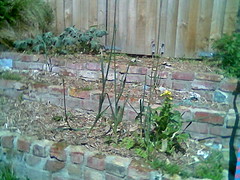
This is a great time of year for gardening. Our produce garden is getting better, with more of a focus on perennials this year, as well as fruits and berries. Next year, maybe livestock! Here's some photos:

20 October 2008

Cutting fire wood

The power line fellas came around and dropped a tree in the front section a few months ago. I went down there and put my tarp over it all as a kind of claim to ownership, because the front section doesn't appear to be ours. People might get to thinking the wood was up for grabs.

I eventually found a chainsaw to loan and cut it all up. We probably got about 2 months worth of wood out of it. The next few days I cut up the vine covered trees out the back. At least another month of wood in that pile too. I quite enjoyed using the saw :)

05 July 2008

firelogs

Well, the wind, rain, snow and cold is driving in on Dunedin today, and we're all thinking about heating. Here's my story so far...

Last week I ordered $100 of "dry, eucalyptus firewood". The fella came and tipped it on the lane in front of my house and served me the bill plus delivery fee. (I'm still getting used to the quality of service in these parts). As I was shifting the pile to a better place I couldn't help wondering how heavy and wet it felt. The delivery fella was long gone and anyway, I'm sure he would've palmed me off with some remark like "sweet as mate" or "nah, its as good as gold". On the first day we tried to use it we were bitterly disappointed. Hard to start, a log actually kills the fire if its not hot enough! This stuff is still wet and green!

So we went and picked up a few old packing pallets from the hardware stores that give them away. Pallets come in pine, oregon, and even eucalypt! After breaking them up we have good heat. I'm very reluctant to waste the expensive load of firewood on the flame if it is not properly seasoned, and there's no way in hell I'm going to drive our power bill up from a nice $40 per month to well over $250 per month just through electric heating! (our neighbours hit $420 last month!!!)

Enter the firelogs we found down at the warehouse. We discovered these things for the first time this week and we're liking them! Made from compressed sawdust and although the box says nothing added, I suspect they have paraffin wax in them. These things burn hot and long! I estimate that one firelog burns for about 1 hour. A box of 8 costs $6, and you could make a box go one night in a good firebox. So by my estimates it would cost $180 a month to burn firelogs. It costs about $120 a month on delivered firewood.

For $60 extra what do we get?

Ready to burn, cleaner to burn, better heat, excellent cooking coals, very tidy, no chop chop, easy storage, easy portability, feel good for using a waste product...

If we could find dry seasoned wood, we'd probably go for the cost savings over the firelog - unless we find a cheaper supplier. We really like having a fire, it is miles better heat and more reliable than our neighbour's air conditioner. And our firebox seems to cost about the same to run as an airconditioner. I think we'll be planting a few eucs down the front section this winter - they might come in handy a few years from now...

26 April 2008

Winter crops

I put Broad Beans (seed), silver beet and celery (seedlings), in my zone 2 yesterday. I should perhaps put more BB in as I only planted about 20 along a trellis.

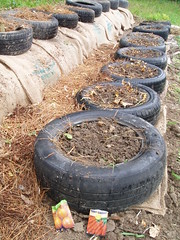
I planted seeds for baby carrots and onions in tires up in my zone 3. The potato tires worked well through summer. I got a pretty good yield considering the condition of the soil and my lateness (again) but must of all I have noticeably better soil after the potatoes. I'm hoping for great carrots and onions now, and have a theory that the tires will help keep the soil a little warmer (if that a good thing for carrots and onions?)

I put seeds for spring onions and chinese broccoli in my zone 1. I'm still looking for miners lettuce and sorrel. I also put in a range of herb seedlings (Thyme, rosemary, lemon balm, oregano, russian (tarramond?).

After all this, I'd really like for people to come around and check it out! I am totally in love with this whole process, and the fact that at the age of 32 I am finally getting to know where food comes from. As well as feeding my wife and I (hopefully) the whole process has been very therapeutic.

02 March 2008

Base Map

Our first assignment for the permaculture design course has been to draw a base map.
A base map is a drawing that captures everything that is in place already on a property or space. It includes buildings, fences, trees, hedges, pathways and driveways, power lines and pipes... things that are in place.


Here's my Base Map:


Google maps does a pretty good job at capturing it too...


View Larger Map

so, we're on a steep NNW facing block that is reasonably sheltered from all winds, although the cold Southerlies can touch our front pretty hard... but now I'm starting to get Sector Analysis about it, which is what I should be focusing on this week:
A sector analysis map is a drawing that depicts what is happening in that base. What is the sun's path, what are the wind and rain directions, where are the main areas of people activity, where are the shade areas.

Permaculture course progress

So I've been going along to the Sunday sessions for the Permaculture Design course, where we have been focusing a lot of time on the principles and ethics of permaculture. I agree that these need a lot of time and they are quite inspiring ideas that could be applied to just about everything we do (even organisationally), but I get a sense that the face to face participants might be feeling that the course is moving too slowly and that they would like to start getting into more tangible activities.

I'm really glad though that the online group is there with us. Their emails and blogs have given me a lot of motivation to research and maintain the course wiki and related resources, which in turn has kept me feeling as though the course is very active. However, because the face to face participants seem to be not participating online, they may be feeling that the Sunday sessions aren't moving along quickly enough. Today Kim and I spent a few minutes showing the face to face groups around the online work being done, so I hope some of them will come on and start putting more into the course so that they may get more out of it, but I suspect that that is not what they expected when they enrolled in the course.

So far we have the course wiki that includes the course schedule and links to any media recordings we capture throughout the course, as well as a discussion page that captures the latest from the online participant blogs (we're still waiting on 3 more). We have also started a Permaculture Design textbook over at Wikibooks that would at first appear to be all by me, but I've simply been copy and pasting the handouts, and some of the notes from the participant blogs as a process of my own study in the course. The text will hopefully evolve into a self sustaining resource for many others to use once it reaches that critical wiki point. And there's an email forum running for people to keep in close contact if they struggle with anything other than email.

What has surprised me is the level of interest that was quickly expressed by people from Portugal to Vermont, and how web savvy they all are :) It turns out that international interest in permaculture is quite high, which is easily verified by the extensive network of websites and media over the Net for it. With the the online participants helping us to use this pilot course to develop online communication channels and information, we will hopefully have a certificate level course soon, with an online study option, that will help enhance and sustain the face to face course.

26 February 2008

Enrolled in a Permaculture Design course

Just a quick note to say that I've enrolled in a Permaculture Design course. I intend to use it to design a plan for our house, as well as my place of work. The course is doable online too. I am helping with the development of that, drawing content from the face to face course as it goes along. We already have a great group of online participants from all around.. it has a good feeling about it :)

08 January 2008

new shoots, but new pests

Took out the two broccoli today. They looked ready, but taste a little sour :( I wonder if their taste has anything to do with the soil they were in. They where in very clay soil, their leaves had been chopped by slugs, but a used no sprays... they certainly look healthy, but taste sour. Perhaps I picked them too soon or too late?

The cauliflower and brussel sprouts have a little bug all over them. The damage appears to be minimal, but I don't know what they are and so have no idea how to get rid of them.. I've done a brief search for cauli pests, but can't find anything that looks like what I have here... They could be mealybug but I'm not so sure. The mealybugs I know are more white than this grey colour, and are flatter and harder to see as bugs. These are easy to see as bugs.. note: the Internet needs a user generated image index where I can just scan images of pests categorized by their colour and size perhaps... or upload my own image for others to help identify...

Finally, we have some fruit buds on the tomatoes, and new shoots on the potato tires :)

21 December 2007

native strips

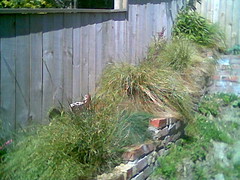
As for the native garden, well I'm very happy with that. The grasses have really taken hold, and I'm kicking myself for planting so many different types. My personal favourite are the red tussock and the rainbow tussocks. Pictured here is a bunch of tussocks I can't even remember the name of. I've been pulling clumps and transplanting to other areas in the native beds, and I'm looking forward to a dense cover of these grasses everywhere!

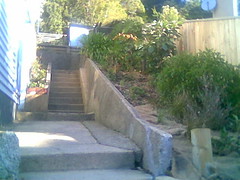
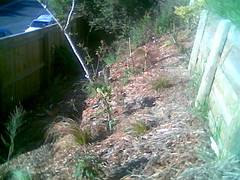
The south side is doing very well with hebes, three and five fingers, ferns, manukas and kanukas, and a range of grasses. But the battle is keeping the weeds back given the steep ground makes mulching difficult. The trees have started over the fence line, and we even have a bit of an understory happening. I reckon it will look well established in about another 2 years.

The front is looking good, but still very young. Its another steep section so mulching was difficult. We layed boxing board over the lawn that was there, and covered it with woodchip. The woodchip has bonded well, covering the steep ground and generally holding on top of the cardboard nicely. We are putting medium to large trees in this part for privacy, and as they aren't expected to grow much higher than 3 - 6 metres, they won't shadow the house, thanks to the steepness and distance from the house.

Holidays at last. Vege garden to replenish the soul

First day of my Christmas holidays so I thought I'd build up a row of potato tyres. I'm told that its best to plant potatoes right at the end of winter.. well, its apparently summer, but I reckon its only just starting so to hell with it, in with potatoes.. lets see how they go.

The sunniest spot is up the back. I leveled off about 8 meters and lay some cardboard, then old tyres on top. We are on such a depressingly tight budget that I couldn't afford a bail of straw, and I need to terrace the back anyway. So I dug a lower step terrace and shovelled the soil from that up into the tyres. Needless to say I'll have to battle weeds :(

I think I put in about 30 seed potatoes in the end. About 3 in each tyre. The plan is to add another tyre on top when/if they shoot through and cover them with another heap of soil. That way the terracing gradually gets done, and the potatoes give a better yield. Hopefully.

As for the rest of the garden, well its doing OK. I wouldn't say it's been as good as last year though. We planted much earlier for a start, so growth up until now has been slow. Because of the slow growth, the snails have really damaged the seedlings and we lost quite a lot. I reckon it is better to plant later in the season, say about now so that the growth is fast and the environment is dryer so that snails and the like have less of an impact.

As usual the spinach has done really well. This year we bought a variety that has brightly coloured stalks. It all tastes the same, but the colour does help bring some life to my very average cooking abilities. The spinach was not touched by the snails, and it is almost finished in terms of going to seed. So it is easily possible to get two crops of spinach in a season here. Think I will put another bunch in. I like eating spinach, but it might be better to plant a few weeks apart so that yields don't come all at the same time...

Our strawberries are doing well and have just started to put runners and berries out for the season. This is the second season for the strawberries. We have started a second patch down the side of the house which is already doing very well. As usual the birds are having their go, but so far there's enough to go around. I've since been told that strawberries to better in a greenhouse. Actually, I suppose everything does better in a greenhouse, if only we had one :( Not only would it obviously be a better climate for growing, but it would keep the birds off the strawberries and other fruits. I'm not yet a sophisticated gardener though, but I imagine the greenhouse would also keep important bees off the flowers. I'm not sure what plants need bee help to pollinate, but at this stage I buy new seedlings and have not experimented with propagating and pollinating...

We dug up and potted our parsley, oregano and mint through the winter on the advice from Andrew, another garden blogger in Dunedin who informed us that these herbs can run away and become a bit of a weed problem. So we're keeping them under control in pots. The parsley went to seed and I tried to keep it cut back, but it kept doing it. Now we are left with 2 very manky parsley bushes that I hope will recover to their former glory.. The mint has not really recovered from the potting insult, but the oregano is doing very well.

This season we also planted quite a few Brussel sprouts. They haven't budded yet, and I'm not sure how they do. Hopefully they won't be like Broccoli or Cauliflowers and bud one per stem. That would be a bit disappointing given all the foliage they put out! I'm pretty bumed by broc and cauli, and hardly think they are worth it with all the space they take up.

Last year's yams are having another go despite me being sure we combed every yam out of there. I like a hardy and easy to grow food like yams, and they roast up quite nicely. I suspect this yield will be very small not in numbers but in size. Last year's were smaller than their parents (from the grocer), so I suspect its one of those things that keep degenerating. I hope they are not engineered to do that!?

We also have onions going everywhere and they seem to be doing quite well. But same again, a lot of foliage for only one bulb... but at least their foliage doesn't take up too much room and seem to cope quite well in the crowded bed we have.

The tomatoes also went in early and we lost about half to a late frost. The survivors are doing well now though but have become crowded with potato sprouts from some old compost under them. I'm leaving it for now as the potatoes seem to be doing a good job supporting the tomatoes and not over crowding them.. I'm watching though. Tomatoes are another one that I've been told only ripen in a greenhouse. But they are also one that needs pollinating.. so it will be interesting to see if we get a yield from them and if their fruit resists pests...

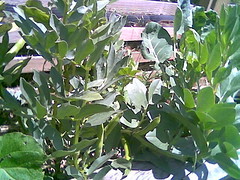
Another newbie to the veggie beds are these beans. They really took off and again we planted them early. They have put out a good yield already, and continue to put out to date. They have not been bothered by any pests apart from me, and I've had quite a few nice dishes mixed with the spinach. Like the spinach, these might be worth staggering the planting and going for two crops in the one season given how fast they grow early on. Not sure how the seedlings would go with a late planting.. but will test it out.

The late frosts also took away a bunch of Bok Choy we had in. That's the last survivor already in flower amongst the onions. While this trial has put out quite a few leaves, the snails liked him and the others early on. That with the frosts, I'm amazed this one made it. I'm glad it did though, as I've discovered that the snails are now leaving him alone, and I've had enough to be able to cook him up. I prefer the taste of bok over spinach, so I think I'll have another go at it now that its later in the season. I'm hoping it will still grow quickly, and that my theory about the snails will hold...

One last report, this one for the green grape hybrid we have in. It is growing quite well through the summer, but no buds yet. Maybe we'll see no grapes this season. Its a romantic looking vine though and one I like to watch grow. Around it we have the strawberries, and a pretty sad attempt at a range of lettuce. I don't think I'll bother with lettuce again... Up the other end we have beetroot going very well! It was also planted early and has survived the frosts and the snails. I can see the bulbs starting to show, and have read that you can eat the leaves in a salad... quite a useful food crop that beetroot!

13 October 2007

Starting to plant

I've not tried the crops Andrew is putting in, but I had good yields after planting this time last year:

  • Yams
  • Potatoes
  • Sweet Potatoes
  • Spinach
  • Parsley
  • Mint
  • Oregano
  • Strawberries

I had very average yields of:
  • Broccoli
  • Cauliflower
  • Broad beans
  • Onion

And failed with:
  • Pumpkin
  • Passion fruit

It was mainly the winter frosts that finished off the pumpkin and passion fruit. Every thing else survived through and is catching on again now. I'd really like to see the passion fruit work so I might relocate it to a more sheltered spot. Interestingly I put a second round of onions and spinach in half way through last summer and now they look as though they'll produce good yields early this summer. They didn't mature before last winter but survived through to now. As a result they are far more dense than the early summer crops I put it, so I'm looking forward to an early high yield on them.. but I seem to recall reading somewhere that onions mature when colder days start coming...

This time I'm trying tomatoes and capsicum but reckon its unlikely I'll get much there. I've put some seedlings in today so we'll see how they go.

What I ultimately want is a fairly self sustaining garden. Something I can dip into when I'm cashless or forget to do the shopping - so staple foods really. I don't really want to be constantly tending it and worrying about frosts and winds etc, so I'm looking for hardy crops like yams and potatoes.

I have a lemon, grape and fig tree in, but no movements there yet. Hopefully they'll make good progress this Summer.

My soil is pretty good and moist, with clayish areas and doc and clover growing generally all over - which signifies low nitrogen apparently.

I've started emailing a few permaculture people to see if there are people here with more local knowledge, or working bees etc. I'll blog what I find out.