Pretty disappointing first ski in Australia. Love the backcountry atmosphere, hate the massive fees and over done resorts.
Got up early, easy driving to Cooma for breakfast and take away lunch (will stop at Berridale next time), lovely sunrise coming into Jindabyne. Stopped at Paddy Palin's for a map, then onto the Park gates for the nasty surprise of a $27 fee for a 1 day pass! Then a few ks up the road, a random chains check!!!? No warning signs back at Jindabyne, no snow anywhere near the road, no forecast of snow for days, if not weeks. They wouldn't hear it, and turned me back to Jindabyne to get chains! Another $25 hire, so I bought a set for $160. There went my early start, budget well blown.
Finally arrived at Perisher to find the road to Charlottes Pass closed with no snow on it! $48 for a 15min bus ride.. forget it! Perisher was crowded out with only man made snow runs open, yet they were charging full fee lift passes at $110 for a day! I just wanted to get out back, but their $28 single lift pass is not available for people with skis!
So skinned up Back Perisher Mountain for good views out to Main Range. Looked like good cover out over Carruthers Peak and Blue Lake, probably a strong crust on it though, and having not gone through to Charlottes, the walk was huge! Very patchy cover on the ridges Mnt Perisher to Blue Cow - fun for cross country. I dropped down to Blue Calf, and up Blue Cow for one run down a crowded Kamikaze.
Tired and broke, I walked back to the car and drove home. Studying the map for less expensive access alternatives. Fuel from Canberra return is about $60, park entry is $24 per day. This cost would be less if the Snowpool website works out, leaving a little for a lift pass, or a bus to Charlottes to access the backcountry for a day trip.. otherwise it's a long walk and a sleep out.. but then the park fees build up!
I hear Victorian parks are all free entry...
Some photos of this trip.. forecast says a dump to come late next week!
08 July 2010
21 June 2010
11 June 2010
Our container house
 Labels:
australia,
canberra,
container,
permaculture
Labels:
australia,
canberra,
container,
permaculture
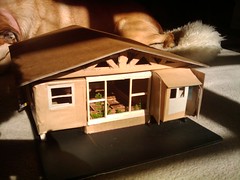
For a few years now, Sunshine and I have been researching shipping container houses as an alternative means to affordable housing. The key to a container based house is the portability. Our 60m2 free standing design retains that portability, with all external elements such as roofing, doors and walls, fitting inside a container ready for transport, quick setup and quick break down.
The reason we want a portable house is so we can move it temporarily onto rented land, save up for our own land, and relocate it to settle and extend. Our plan is a two stage approach to home and land ownership, attempting to keep our weekly payments as low as possible while we go.
If you have a small section of land you could rent us, we can offer you between $50-100 rent per week. We'd then secure a loan of $40 000 for the prefabrication, additions and delivery of our container house. The weekly repayments on such a loan would be $250 over 5 years. The land rent and house repayments together would total $350 per week. We think we could save between $100-200 per week, or $5-10,000 per year, $15-30,000 over 3. That's a deposit for our own land, and once we had our own land, we'd move off yours, leaving behind a little fruit orchard, a herb garden, and a small rammed earth pad, where we once stayed.
Here's a set of photos of inspirational projects and our design in a cardboard model.
Costing breakdown - new, recycled and 2nd hand materials:
- 2 modified 20foot high cube containers delivered: $10000
- Roof and trusses: $7000
- Insulation and linings: $3000
- 4x (1.2x3m) sliding, timber framed, double glase walls: $5000
- 1x (4.8x3m) back wall with window and door: $3000
- 6x5m rammed earth floor: $3000
- Kitchen: $2000
- Waterless toilet: $2000
- Shower: $1000
- Plumbing, storage, pump, outlets: $3000
- Power generator, storage, cable, points, lights: $5000
- Rocket fire, thermal mass heater: $500
- 2x doors: $1200
________
$45900 for stage one
If you think you can offer us a small section of land, let's talk.
If you think you can offer us a small section of land, let's talk.
06 June 2010
The local paper heats my water
Labels:
canberra,
permaculture
The Canberra Times ran a story on our compost hot water system today, after a local radio station rang up for a quick live interview a few days ago.

Patrick Blampied is doing a great job with the media and PR for the Permaculture Research Institute of Australia, and sent out a press release about me after we met through Youtube. I'm more than happy to help build their profile in Canberra, although between the journalist, Pat's press release, and me seeing the story in print, some minor corrections and clarifications are needed:

- I don't start each day with a warm feeling about environmental sustainability. I get that feeling working towards conviviality.
- The correct order for being inspired to try this started with a Youtube video by Permascience, leading to information about Jean Pain, eventually seeing a video by Patrick that the Permaculture Research Institute of Australia were using the method too.
- My pile (version 3 that is) is made of horse manure, straw and woodchip, not paper. Paper is a good suggestion - but slightly harder to come by around here.
- I don't think or imply this system is for everyone, and I don't think it would reasonably replace existing systems.. not before a bit more research and development was done. I have concerns about the HDPE pipe possibly putting a chemical into the water for a start, and I think the biomass needs to be semi sealed to keep flies away. Patrick and I reckon something like a wheelie bin would probably be good, hooked up to a storage tank, with a replacement bin at the ready each week or so. Either that, or use the V3 system for room heating instead of shower water.
Apart from those minor points, it was great to get some interest from the local paper, and I hope it helps lead me to good local connections for progressing this and other projects. Thanks Patrick.
22 May 2010
Starting a rocket stove thermal mass heater
Labels:
canberra,
container,
permaculture

I discovered rocket fires last year when Permaculture Keith blogged about them. That lead to a couple of Youtube videos, which lead to meeting Erica and Ernie in Portland Oregon to see one in action.
Since that visit, Sunshine and I have been busy selling our house in NZ, moving to Australia, and having a baby. Now in a rental, its difficult to commit to a full build, but I've found a bit of time to study the method.
Basically, a rocket stove thermal mass heater is a super efficient wood fuel heater that can be built by just about anyone, using waste and/or easily collectible materials. To give you an idea, in Dunedin we used an efficient and certified wood burner that used about 4-6 cubic metres of wood per year. Erica and Ernie told us they use about 1-2 cubic metres in their rocket heater, and their house was less insulated than ours!
If you want to get a sense of what a full rocket stove thermal mass heater is, this is a great introductory video:
Here's the book that the video refers to.
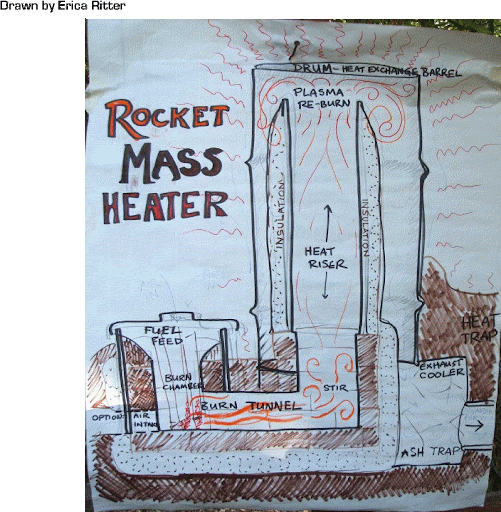 And here's a really good illustration by Erica, of the critical design of the rocket stove. At that link are a series of photos documenting a full build, including the thermal mass heater.
 Here's another photo documented installation with some adaptations to the standard design, by Michael Blaha.
And I started the Wikipedia article to see where it might go.
My attempts so far
So begins my attempts to study and learn this technique for heating. After the usual terrible time trying to source materials in Canberra, here's a series of videos of my first mock up.
Canberra is an incredibly difficult find out about anything online. The websites are crappy and the search results are worse. As a result, sourcing materials is frustrating. All we needed was some short lengths of steal pipe at varying diameters, a few steal drums of varying sizes, about 10 fire bricks, and 10 normal bricks. So I baled the family into the care and drove around looking for word of mouth. The main waste recycle facility was useless. We found private waste recycle yards that looked promising, but were all locked up with no one around. Everyone we spoke to directed us out to Fyshwick, the industrial hub of Canberra. There we found some materials, but all set at exorbitant prices :( It seems what useful materials is recycled, is pretty well stitched up by business. But we did manage to scrape together a few bricks and some guttering just to get this first mock up made.
The hunt for better materials continues...
Subscribe to:
Posts (Atom)